

23rd August 2016
Canal & River Trust Press Release
Local people are for the first time being given the opportunity to venture underground and explore a 240 year old canal tunnel which has been abandoned since it collapsed over a century ago.
 Engineers from the Canal & River Trust, the charity that cares for 2,000 miles of waterways in England & Wales, are set to carry out a ten yearly inspection at Norwood Tunnel near Kiveton and, for the first time, are inviting a limited number of people into the tunnel to see it for themselves.
At 2.6km long Norwood Tunnel was the longest canal tunnel in Britain when it was officially opened in May 1775. However subsidence from nearby mining works led to sections of the tunnel sinking and, despite efforts to raise the roof, it finally collapsed completely after heavy rain in October 1907.
The collapse effectively cut the Chesterfield Canal into two sections and trade on the Western section of the canal ceased between 1914 and 1918, but continued between Kiveton Park and West Stockwith until 1955.
Today the eastern portal of the tunnel is bricked up for safety reasons and so, before the inspection can take place, the engineers will have to break through the brick wall.
Once through they will use a small dinghy to inspect the 475m stretch between the eastern portal and the collapsed section. The engineers will be looking for signs of cracks and leaks and to assess the overall condition of the tunnel.
As part of the project the Trust is taking the opportunity to give a small number of guests, including volunteers from the Chesterfield Canal Trust, the chance to venture into the tunnel to see for themselves.
Seán McGinley, waterway manager for the Canal & River Trust said; “This is a really exciting opportunity and it’s like opening up a giant brick time-capsule.
“It’s going to be fascinating to get in there for the first time in a decade and see how the tunnel’s looking. It will be particularly special for local volunteers from the Chesterfield Canal Trust who have been working for years on plans to restore the canal and link the two sections either side of Norwood.
“We think giving them the opportunity to explore is a fitting reward for all their dedication and hard work over the years but it will also hopefully create some wider interest and inspire more people to get involved and support the restoration of the Chesterfield Canal.”
One of the nation’s most celebrated engineers James Brindley was working on the tunnel at the time of his death in 1772 with the project then passed to John Varley and latterly Hugh Henshall. At just 3m wide the tunnel doesn’t have a towpath and so boats would have been propelled through by legging, where boatmen would lay on the roof of the boat and walk along the tunnel’s ceiling.
Robin Stonebridge, chair of Chesterfield Canal Trust said; “The Norwood was without doubt one of Brindley’s gems, and we would like to see it used as part of the canal restoration. The tunnel has been considered for many years as the one obstacle to further restoration of the Chesterfield Canal. We view this as a great chance to see what state this part of the tunnel is in, and work with the Canal & River Trust on how we can get the canal up into Kiveton Waters.”

Monday 22nd, a gang started to break open the tunnel entrance the day before.

Imogen Wild (C&RT Ecologist), Andy Newton (Rotherham MBC Economic Development Team Project Officer), Robin Stonebridge (Chair, Chesterfield Canal Trust), Richard Parry (Chief Executive, C&RT), Seán McGinley (Waterway manager, C&RT) and Richard Wakelen (National Asset Strategy Manager, C&RT) wait for their turns to go into the tunnel.

Seán McGinley was interviewed by ITV Calendar News …..

….. and then by BBC Look North.

John Lower was also interviewed by Look North.

They couldn’t decide upon a good spot, but ended up right in front of the tunnel mouth.

Finally, the ITV guys went down for their trip.

At one time both cameramen were filming together.

John Lower went with Richard Parry for their ride.

See the amazing stalactites.
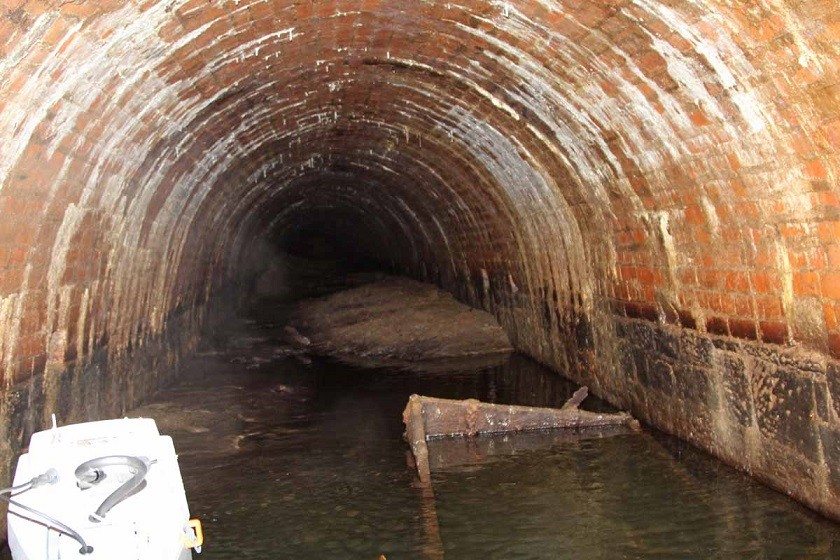
We now see John’s photos taken in the tunnel. This is at the far end, about 450 metres in. There is a sunken old inspection boat. Beyond appears to be silt for a good length. Photo © John Lower
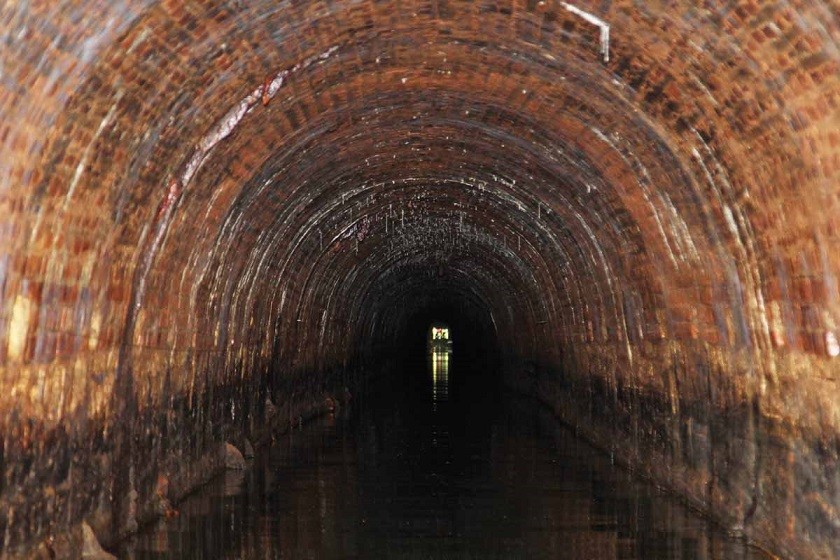
This is on the way back. Photo © John Lower
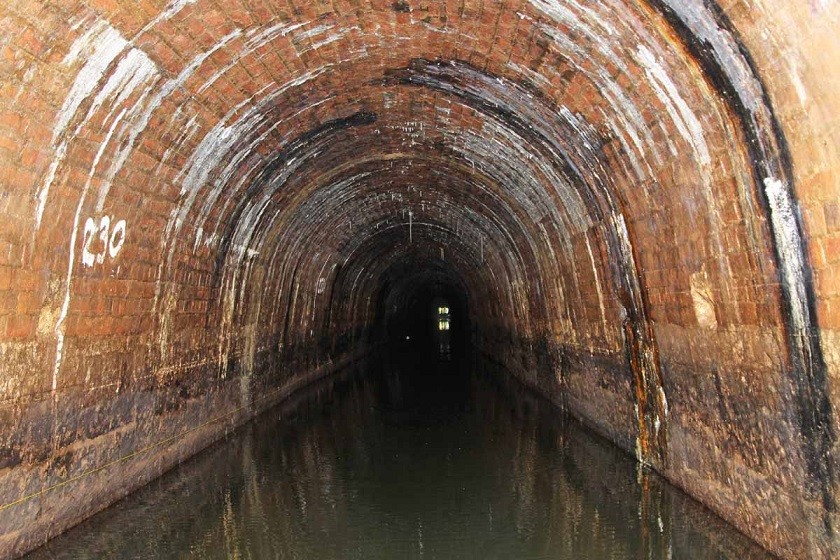
There are distances in metres painted on the wall. These are modern. Photo © John Lower

From about 160 metres to 100 metres it was misty due to the temperature change ….. Photo © John Lower
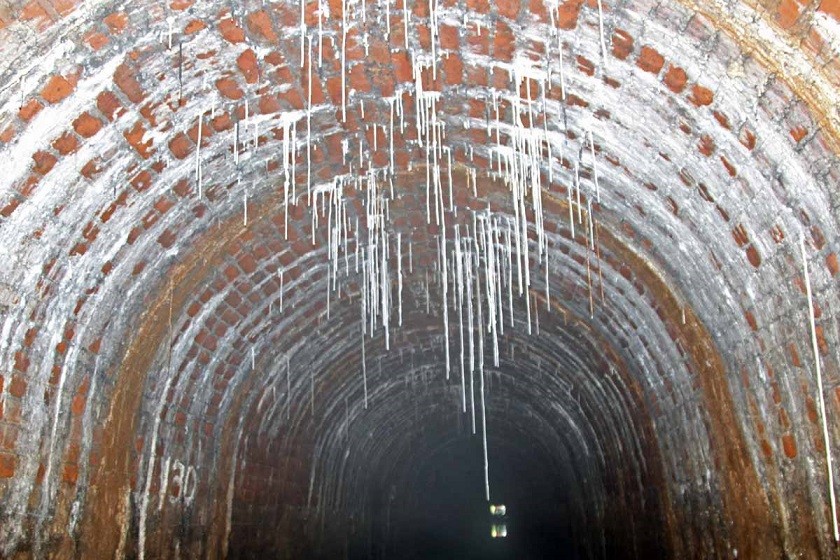
….. but the stalactites were incredible. Photo © John Lower

Note the superb reflection.

Coming back, the light gave an amazing effect shining on the brickwork.

The entrance to the tunnel has the bricks that have been knocked out from several tunnel inspections.
To see the Look North report, click here.
To see the C&RT video, click here.
To see our own video, click here.
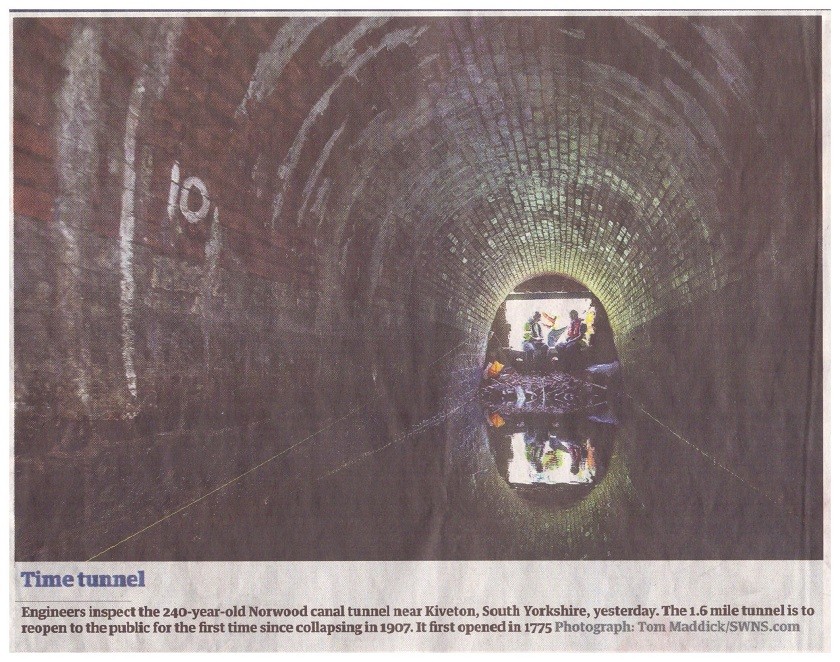
We were delighted to see that the story reached the Guardian newspaper. This is from Page 12, 24th August.